
The Supreme Court handed down judgment in Mitchell v Al Jaber [2025]



Andrew Butler KC looks at implied obligations of good faith in commercial contracts.
The Rise and Fall of Implied Obligations of Good Faith since Yam Seng
It is now nearly 13 years since the decision in Yam Seng Pte Ltd. -v- International Trade Corp Ltd. [2013] 1 CLC 662 catapulted the debate about the implication of terms of good faith into contracts into a prominent position in the minds of commercial litigators. It has never truly yielded that place since. The purpose of this article is to explore the ups and downs of the doctrine over the intervening years, and to bring to the attention of readers a forthcoming case which will give the Court of Appeal the chance to grapple with this topic in a way which it has not yet really done.
It is perhaps helpful to start with a reminder of what Yam Seng was about. It was a claim brought by a Singaporean company which had entered an agreement with a British company which gave it a licence to distribute Manchester United-branded fragrances in certain regions across Asia. The company, Yam Seng, made several allegations of breach which it said justified them in terminating the agreement. Among other parts of their case, Yam Seng alleged that the contract should be read as containing an implied term that the parties would deal with each other in good faith.
Leggatt J, as he then was, heard this claim and held that “following the established methodology of English law for the implication of terms in fact”, there was no difficulty in implying such a term into ordinary commercial contracts. He held that what that obligation would require was sensitive to context but that it “includes the core value of honesty”, but that it also went further, and extended to “conduct which would be regarded as commercially unacceptable by reasonable and honest people”. Leggatt J indicated that so-called “relational” contracts, require a high degree of communication, cooperation and predictable performance based on mutual trust and confidence would be particularly fertile ground for the implication of such a term.
It is fair to say that Yam Seng did not meet with immediate judicial approbation. The next case in which reliance was sought to be placed on the implied obligation was Hamsard 3147 Ltd. -v- Boots UK Ltd.. [2013] EWHC 3251 (Pat), decided in October of that same year. In this case, Norris J rejected the attempt to imply the term “on the facts”, holding that it was “not obvious” that the parties would have intended a clause about good faith to form part of their bargain. He observed that he did not regard Yam Seng “as authority for the proposition that in commercial contracts it may be taken to be the presumed intention of the parties that there is a general obligation of “good faith””, or that “there is to be routinely implied some positive obligation upon a contracting party to subordinate its own commercial interests to those of the other party”.
Henderson J expressly agreed with these words in Carewatch Care Services Ltd. -v- Focus Caring Services Ltd. [2014] EWHC 2313, a decision given in July 2014.
However, in appropriate cases, Judges did show themselves willing to adopt the line taken by Leggatt J in Yam Seng. In the same month that Carewatch was decided, Richard Spearman QC sitting as a Deputy Judge held that an obligation of good faith should be implied into an agreement between a provider of training to pilots, and a publisher of training material, and that it had been breached by the publisher, in anticipation of a falling-out, surreptitiously accessing the training company’s computers and downloading training material for sale (Bristol Groundschool -v- Intelligence Data [2014] EWHC 2145 (EWHC)). Another such case was D&G Cars Ltd. -v- Essex Police Authority [2015] EWHC 226 (QB). The contract in this case was a long-term contract between a police authority and a vehicle recovery company tasked with recovering vehicles which had been used for the purposes of crime. In the view of the trial judge, Dove J, there were four features of the contract which justified the implication of an obligation of good faith, namely:
He held that by incorporating a recovered vehicle into its own fleet, the company was in breach that obligation. The judgment also contains some observations on the content of the duty, again going beyond the strict limits of dishonesty; they were, Dove J said, “obvious acts inconsistent with the maintenance of the long-term relationship of fair and open dealing”.
Then in April 2016, the issue came before the Court of Appeal for the first time, albeit tangentially, in Globe Motors Inc -v- TRW Lucas [2016] 1 CLC 712. The reason the issue arose tangentially was because that case really concerned the construction of the express terms of a long-term agreement. Nevertheless the Court saw fit to comment on the implication of terms of good faith in long-term agreements, expressing the cautionary note that “an implication of a duty of good faith will only be possible where the language of the contract, viewed against its context, permits it. It is thus not a reflection of a special rule of interpretation for this category of contract.”
The next decision chronologically was in 2018, when Leggatt LJ, as he then was, tried a case called Al Nehayan -v- Kent[2018] EWHC 333 (Comm). This was a dispute between two business people who were in a joint venture. The Claimant, Mr Kent, held that he had been induced to enter into a compromise in the course of this venture by unfair means, including threats and duress, and in breach of implied obligations of good faith which Al Nehayan owed him. Leggatt LJ, perhaps unsurprisingly, took the view that his decision in Yam Seng had gained traction, and cited Bristol Groundschooland D&G in support of this. He did not, however, mention Hamsard and Carewatch, in which the respective judges had adopted much more circumspect positions. Having been unable to find that Mr Al Nehayan had breached any fiduciary duties which he owed to Mr Kent, Leggatt LJ did however hold that the joint venture agreement was a relational one in which duties of good faith should be implied. These, he held, had been breached by certain kinds of “furtive and opportunistic” conduct on the part of Mr Al Nehayan, including entering into negotiations to sell his shareholding without telling Mr Kent, and using his position as a shareholder to obtain a financial benefit at Mr Kent’s expense.
Then a year later came the case which probably represents the high water mark of the doctrine of implied terms of good faith. That was the famous case of Bates v Post Office [2019] EWHC 606 (QB), in which judgment was given on 15 March 2019. Issue 1 in this case was: “Was the contractual relationship between the Post Office and Subpostmasters a relational contract such that the Post Office was subject to duties of good faith, fair dealing, transparency, co-operation, and trust and confidence?”, with specific reference being made to Yam Seng. Holding that there was a recognised species of contract in English law called a relational contract, Fraser J identified certain factors which he said were relevant in determining whether a particular contract fell into that category or not. These were:
Among the many other points which could be made about this decision – and, as we shall see, many have been in the intervening years – it might be thought that it is conducive to an unnaturally binary approach, in which contracts falling one side of a line are laden with implied obligations of good faith, and contracts falling another side of it are not. Put in crude terms, it leads in theory to a view of the law in which a contract for a period of X months is subject to such terms, whereas the same contract for a period of X months less 1 day is not. It is debatable whether that can lead to a coherent or logical position.
It is also the case that Fraser J, much like Leggatt LJ before him, rather swept under the carpet certain authorities which did not resonate with his view. Authorities in which contracts were held not to fall within the category of being relational were treated as supporting the proposition that the category of contracts nevertheless exists.
It did not take long for cracks to appear. Six months after Bates, Fancourt J gave judgment in a case called UTB -v- Sheffield United Ltd. [2019] EWHC 2322 (Ch), one of two major decisions relating to a boardroom battle for control of that football club. Again, implied obligations of good faith were relied upon and it fell to Fancourt J to decide, inter alia, whether the underlying contract was a relational one. At para.202 he sounded what might be thought a wise note of warning, observing that “…there is a danger in using the term “relational contract” that one is not clear about what exactly is meant by it. There is a great range of different types of contract that involve the parties in long-term relationships of varying types, with different terms and varying degrees of detail and use of language, and to characterise them all as “relational contracts” may be in one sense accurate and yet in other ways liable to mislead. It is self-evidently not all long-term contracts that involve an enduring but undefined, cooperative relationship between the parties that will, as a matter of law, involve an obligation of good faith.”
He went on, at para.203:
“Rather than seek to identify and weigh likely indicia of a “relational contract” in the narrower sense used by Leggatt LJ, it is, I consider, preferable to ask oneself first – as Leggatt LJ did in the Sheikh Tahnoon case – whether a reasonable reader of the contract would consider that an obligation of good faith was obviously meant or whether the obligation is necessary to the proper working of the contract.”
In other words, one should start with the question of whether an obligation of good faith can be implied by the normal yardsticks of obviousness or necessity, rather than with an analysis of whether it is properly classed as a relational contract.
In a much later decision, Phones 4U Ltd. -v- EE Ltd. and others [2023] EWHC 2826 (Ch), Roth J expressed agreement with this passage.
In between these two decisions, however, came a case which is certainly worth mentioning in this context, even though it did not involve implied obligations of good faith. That was the decision in Times Travel (UK) Ltd. -v- Pakistan International Airlines Corpn [2021] 3 WLR 727, a decision given in August 2021. It is worth having regard to this for two reasons, first of all because it contains some observations about the place of good faith in the body of English law, and second because it is a decision of the Supreme Court.
Times Travel was a case where a travel agent was driven to waive claims for unpaid commission against the Defendant airline by steps which were lawful but in the nature of economic duress. Upholding the Court of Appeal’s dismissal of the claim, the Supreme Court observed that English law “has never recognised a general principle of good faith in contracting. Instead, [it] has relied on piecemeal solutions in response to demonstrated problems of unfairness”. It is worthy of note that Yam Seng was cited in the arguments, but not referred to in the decision – hardly a ringing endorsement of its status as a first step in a brave new world of obligations of good faith.
In similar vein, in August 2022 the Court of Appeal handed down judgment in a case called Candey -v- Bosheh [2022] 4 WLR 84, in which – improbably – a solicitor sought to argue that there was an implied duty of good faith in a Conditional Fee Agreement which it had entered with its client. Its complaint was that the client had engineered a settlement which did not qualify as success under the agreement, and which thus precluded the recovery of fees by the solicitor. Rejecting the claim, Coulson LJ held somewhat wearily that there had been “something of an avalanche” of claimants trying to establish that their contracts contained an implied obligation of good faith. But, he said, “only a relatively few have succeeded”. He did not however go so far as to say that there could be no such obligation. Rather he emphasised, citing the UTB and Globe Motors cases to which I have made reference above, that the test for implication had to be met and that the “elusive concept of good faith should not be used to avoid orthodox and clear principles of English contract law.”
Candey was cited with approval by a differently constituted Court of Appeal six months later in Quantum Advisory Ltd. -v- Quantum Actuarial LLP [2023] EWCA Civ 12, a case in which I appeared, in which an attempt to use the term to enlarge express obligations found in a very long-term agreement was peremptorily rejected.
And there matters really stood in terms of case-law until 2025, although of note in January 2024 an article was published in Law Quarterly Review under the authorship of Professor Paul Davies and Philip Sales (Lord Sales) writing extra-judicially. Entitled “Controlling contract discretions; Wednesbury unreasonableness, good faith and proper purposes”, this article was unusually excoriating about some the decisions which had led the way in the promotion of implied obligations of good faith, describing the approach taken by Fraser J in Bates as “not a helpful one” and the decision itself as “unconvincing”. The authors express “respectful doubt” as to whether the quest to identify a clearly defined category of relational contracts is a productive exercise.
In August 2025, judgment was handed down in Ellis -v- John Benson Ltd [2025] EWHC 2096, another case in which I appeared, leading Annie Higgo (also of Tanfield Chambers). Ellis was a rather extraordinary case. It concerned a driving school franchise in East Anglia, which was run in a forthright fashion by its proprietor, John Benson. Mr Benson had alienated some of his franchisees, who had got together and asserted a right to terminate their agreements, based on what were said to be breaches of an implied obligation of good faith. These allegations consisted of various types of confrontational and aggressive behaviour, and a disregard for sensitivities to race, sexuality and other similar issues.
There was no allegation that the Defendant had failed to perform any of the express obligations of the agreement, in terms of actually performing the things required of it as franchisor – undertaking marketing, building the brand, providing business support etc. There was also no allegation that Mr Benson had been in any way dishonest. The allegations were essentially that he had behaved in a way which are best described as not very pleasant.
On this occasion I did not succeed, as I had in Quantum, in resisting the implication of the obligation. The Judge, perhaps constrained by authority about franchise agreements, and anxious of the consequences of exposing the whole sector to implied obligations of good faith, rejected the argument that a term should be implied in law. However, he accepted that terms should be implied as a matter of fact. In reaching this conclusion, he attached considerable weight to the respective bargaining positions and experience of Benson on the one hand, and the franchisees on the other.
Turning to the question of breach, the Judge rejected a submission that such obligations were only broken by conduct which was dishonest, or something akin to dishonest, and that, in the formulation “commercially unacceptable to reasonable and honest people”, that first word “commercially” mattered. It was argued that merely behaving boorishly, or failing to respect differences, was not enough to constitute a breach of the obligation, even if it existed. The Judge disagreed, and found that many aspects of Mr Benson’s overbearing behaviour were sufficiently egregious to constitute a breach.
Permission to appeal against this decision has been granted by the Court of Appeal. If it is upheld, it will represent (I would suggest) a significant extension to the parameters of the implied obligation of good faith as they have been understood up until now, and will breathe life into a class of action which was showing signs of running out of steam.
This content is provided free of charge for information purposes only. It does not constitute legal advice and should not be relied on as such. No responsibility for the accuracy and/or correctness of the information and commentary set out in the article, or for any consequences of relying on it, is assumed or accepted by any member of Tanfield or by Tanfield as a whole.

The Supreme Court handed down judgment in Mitchell v Al Jaber [2025]
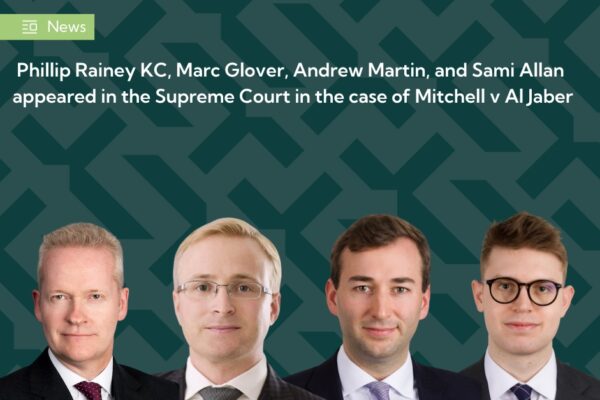
Phillip Rainey KC, Marc Glover, Andrew Martin, and Sami Allan appeared in the Supreme Court from 13 - 15 May 2025 in the case of Mitchell v Al Jaber, in which they represented Sheikh Mohammed Bin Issa Al Jaber ("the Sheikh").